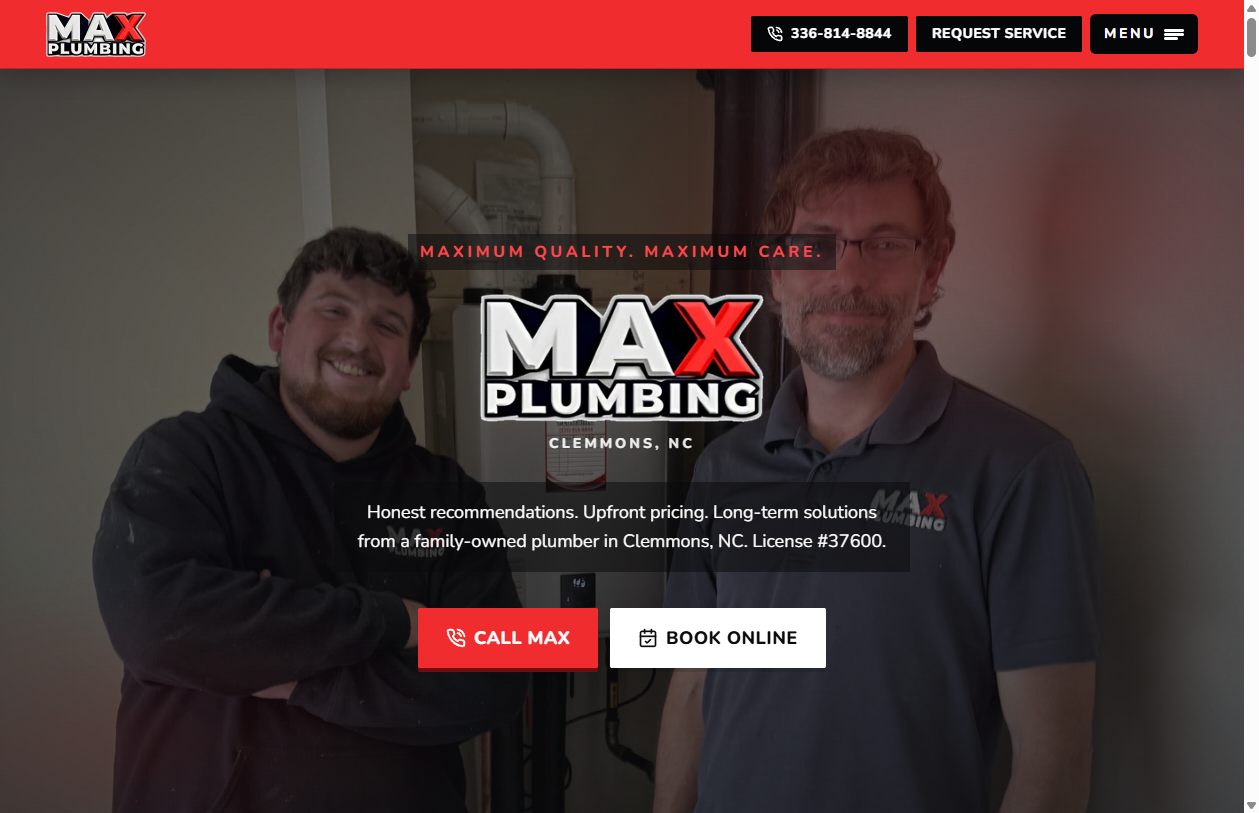
How We Rebuilt MAX Plumbing’s Website and Increased Organic Clicks 175%
Early Search Console results after MAX Plumbing’s August 19, 2026 rebuild: +175% organic clicks, +154% impressions, and an 8× expansion in Google-visible URLs.
When a local service business rebuilds its website, the goal should not simply be to make it look newer. A better website should make the company easier to understand, easier to trust, easier to find in Google, and easier to contact when someone actually needs the service. That was the brief when Koford Media began working with MAX Plumbing, a family-owned plumbing company based in Clemmons, North Carolina.
The project became more than a visual redesign. We rebuilt the site around individual plumbing services, customer search intent, local SEO, service areas, structured data, conversion paths, real project photography, reviews, and the information homeowners look for when choosing a plumber. The new site is still early in its SEO lifecycle, yet Google Search Console already shows a clear shift.
This article is the long-form companion to our MAX Plumbing case study. The case study page carries the visual proof. This post walks through the architecture decisions, the Search Console windows we measured, and what other home-service businesses can take from the early results.
First settled new-site week (Aug 19–25 vs Aug 12–18, 2026)
Organic Google clicks increased 175% (8 → 22). Google Search impressions increased approximately 154% (863 → 2,194). URL rows receiving impressions in Search Console expanded from 6 to 48.
Project snapshot
| Field | Detail |
|---|---|
| Client | MAX Plumbing |
| Industry | Plumbing / Home Services |
| Market | Clemmons and the North Carolina Triad |
| Kickoff | Early August 2026 |
| Launch | August 19, 2026 |
| Work | Custom rebuild, service and location architecture, technical SEO, schema, conversion paths, Search Console monitoring |
| Package context | BOOST-level plumbing services build |
Meet MAX Plumbing
MAX Plumbing serves Clemmons, Winston-Salem, Lewisville, Advance, Bermuda Run, Kernersville, Mocksville, and surrounding communities across the North Carolina Triad. From our earliest conversations, one thing about the company stood out: owner Justin genuinely cares about the business and how customers experience it. That matters more than people might think when building a website.
Justin was a delight for our team to work with. Information, photographs, company details, service information, and requested materials arrived neatly and quickly. Instead of spending weeks trying to figure out what the company does or chasing missing assets, we could focus on translating an already strong local business into a stronger digital presence.
A web agency can improve architecture, design, SEO, accessibility, performance, and conversion strategy. What it cannot manufacture is a business owner who cares. MAX Plumbing already had that part handled. Our job was to make sure the website reflected it.
The Problem With the Old Website
MAX Plumbing already had a website and an established search presence before Koford Media became involved. The problem was not that Google had never heard of the company. The problem was that the website gave Google relatively few meaningful destinations to work with.
A traditional small-business site might include a homepage, an about page, a contact page, and a general services page. That structure technically explains the company, but it does not match the way people search for plumbing help. Someone with a clogged drain is more likely to type “drain cleaning near me,” “clogged drain repair,” or “plumber in Clemmons NC” than “general plumbing company.” The same pattern holds for water heater replacement, tankless installation, emergency plumbing, backflow testing, sewer line repair, and sump pump work. Each query represents a different need.
Trying to make one general services page rank competitively for every plumbing service is asking one page to do the work of an entire website. So we changed the architecture.
Building Around Search Intent
One of the largest changes was giving important services dedicated pages. The new site includes focused destinations for drain cleaning, drain camera inspections, water-heater installation and repair, tankless water heaters, sewer-line repair, backflow testing, gas-line services, sump pumps, water filtration, repiping, well-system plumbing, and related work. Each major service now has a clearer search identity, which in turn gives us control over titles, meta descriptions, headings, internal links, FAQ content, structured data, service-specific copy, conversion calls to action, and later optimization based on Search Console data.
This is why we push for intentional, custom website architecture instead of treating every local business like it needs the same five-page template. A custom-coded website is not valuable simply because someone wrote code. The value comes from designing the structure around the business. For MAX Plumbing, that meant designing around plumbing services and local search behavior.
Extending the Same Logic to Service Areas
Service businesses usually do not serve just one city. MAX Plumbing is based around Clemmons but works throughout a larger Triad footprint. Instead of stuffing every town into the homepage footer and hoping Google figures it out, the new website gives important service areas dedicated context, including Clemmons, Winston-Salem, Lewisville, Kernersville, Mocksville, Advance, and Bermuda Run.
Those pages connect to the larger website rather than floating as isolated SEO landing pages. That distinction matters. A location page should help a customer understand whether a company serves them, what services are available, and what action to take next. It should not exist merely because someone wanted to repeat a city name twenty times.
What Search Console Showed After Launch
From August 12 through August 18, 2026, MAX Plumbing recorded eight organic Google clicks, 863 Search impressions, and a 0.93% click-through rate. During the following settled seven-day period, August 19 through August 25, the site recorded twenty-two organic clicks, 2,194 impressions, and a 1.00% CTR. That is approximately 175% more organic clicks and 154% more impressions week over week.
The preceding three weekly periods each generated roughly six organic clicks. The latest measured period produced twenty-two. Compared with that earlier weekly baseline, organic clicks were approximately 267% higher.
The Search Footprint Expanded Too
Clicks matter, but one of the more useful early signals sat deeper in Search Console. During August 12–18, impressions appeared across only six URL rows. During August 19–25, impressions appeared across forty-eight URL rows. That is an eight-times expansion in the Google-visible URL footprint represented in the report.
That does not mean forty-eight brand-new pages instantly became fully indexed and ranked. Search Console can include legacy URLs, fragments, hostname variations, and other entries. What it does tell us is that Google suddenly had a much broader group of MAX Plumbing URLs participating in search. The old site concentrated most visibility into a handful of pages. The new architecture gives Google significantly more relevant pages to evaluate.
Watching New Pages Enter the Index
The drain-cleaning page is a useful example. Before August 20, it showed no impressions in the Search Console data we analyzed. Then Google began testing it: three impressions on August 20, six on the 21st, eleven on the 22nd, two on the 23rd, seventeen on the 24th, and eleven on the 25th. By the end of that stretch the page had generated about fifty impressions.
It had not suddenly become the dominant drain-cleaning result in North Carolina. That is not how responsible SEO works. But Google had found the page, understood enough about it to place it into searches, and left us with data instead of guesswork.
The Winston-Salem service-area page told an even larger early story. It first recorded impressions on August 20, then climbed through daily counts of 17, 23, 24, 25, and 26 before reaching 94 impressions on August 25 alone. Across that initial stretch it accumulated roughly 271 impressions. Many of those appearances were still far down in the results. A page cannot move from position 50 to 20 to 10 if Google never puts it into the race. Discovery comes first, then refinement, then authority, then stronger rankings.
Early Keyword Movement, With Caveats
Search Console also showed encouraging early movement on commercially relevant terms. In the measured comparison window, “plumbing services clemmons nc” moved from an average position around 21 toward position 1, “plumbing clemmons nc” moved from roughly 17 toward position 1, “drain cleaning near me” moved from roughly 21 toward position 3, and “emergency plumbing clemmons nc” moved from roughly 30 toward position 8.
Important disclaimer
These are still small samples. Individual keyword positions can fluctuate dramatically after a redesign or when new pages first enter the index. A handful of impressions near position one is not proof that an SEO campaign is finished. It is a signal worth watching when the queries are commercially relevant.
Why Average Position Looked Worse
Here is one of the stranger parts of SEO. MAX Plumbing’s overall average position became worse during the same period that impressions rose by roughly 154%. That can look alarming if you only watch one metric, but it fits the expansion pattern.
Imagine the old website appearing in 100 races, then the new website suddenly qualifying for 500. The additional 400 appearances may initially happen far behind the leaders. Average finishing position falls even while overall participation explodes. That is essentially what happened in Search Console. Google began testing more MAX Plumbing pages against many more searches. A new service page might start around position 40, another around 60, another already on page two. All of those impressions pull on the sitewide average.
We would rather see a relevant plumbing page appear in position 40, where we can optimize it, than remain invisible. The work now is moving those new appearances upward.
Local SEO Beyond the Business Profile
One common misunderstanding in local marketing is treating local SEO and a Google Business Profile as the same thing. They overlap, but they are not interchangeable. Google Business Profile, formerly Google My Business, is an important part of local SEO. The website still gives Google a large amount of information about what the company does, where it works, which services deserve their own relevance, how services relate to locations, who operates the business, what credentials exist, and whether the information across the digital presence holds together.
A strong profile connected to a weak website leaves opportunity on the table. A strong website connected to a neglected profile does the same. For home-service companies, the better strategy is usually an ecosystem: website, Google Business Profile, reviews, citations, business information, service pages, location pages, photographs, and reputation reinforcing one another.
SEO Built Into Development
We did not build the site and then open an SEO checklist afterward. SEO shaped the structure itself: service-focused page architecture, location architecture, keyword-informed titles and descriptions, canonical URLs, crawlable internal linking, sitemaps, structured data, LocalBusiness and plumbing-related schema, FAQ information, image metadata, accessibility considerations, service relationships, mobile navigation, and clear conversion paths.
We also connected the post-launch process directly to Search Console. Once Google returns real queries, theory gives way to evidence. If Google repeatedly associates a page with a particular phrase, we can investigate. If a page earns impressions but almost no clicks, we can examine title, description, intent, and position. If an unexpected location starts producing visibility, we can ask why. If two pages compete for the same term, we can correct the architecture. The useful loop is build, measure, learn, improve.
Technical Hygiene After Launch
Technical SEO matters, but it is not the whole strategy. After launch we continued reviewing canonicalization, redirects, structured data, image information, accessibility, sitemaps, indexability, old URLs, and hostname consistency rather than treating go-live as the end of the project.
The pages we audited are indexable, return successful HTTP responses, use self-referencing canonical URLs, contain clear H1 structures, and include structured data. We also found smaller cleanup opportunities after launch, including additional image alt-text coverage and an Organization-schema logo field. That is normal. A website is software. A search presence is an evolving system. Good maintenance means continuing to inspect both.
Designing for Conversion Under Stress
Ranking is not enough. A plumbing company does not make money from impressions. It makes money when someone needs a plumber and chooses to call, book, or request service. The site had to work for humans as well as crawlers.
We built clearer paths to call MAX Plumbing, request service, book online, explore individual services, see service areas, read reviews, view previous work, understand financing and warranties, and meet the people behind the company. One principle guides a lot of home-service design work: do not make a stressed customer solve your navigation. Someone with water where water is not supposed to be does not want a treasure hunt. Help them identify the problem, show the relevant service, establish trust, and make the next action obvious.
Real Materials Beat Generic Marketing
Justin also gave the project an advantage many website builds never receive: real materials, real information, real photographs, real projects, and real detail about how MAX Plumbing operates. That let us build around the actual business instead of filling space with generic plumbing copy and stock imagery.
The difference matters for conversion and for SEO. Search engines are increasingly capable of understanding entities, businesses, authorship, locations, relationships, and broader context. Customers are even better at spotting hollow pages. A polished website cannot replace authenticity. It should organize and amplify it.
What Other Home-Service Businesses Can Learn
MAX Plumbing’s early results reinforce several principles we use for contractors and home-service websites. Important services that generate revenue and attract independent search demand usually deserve more than one paragraph on a generic services page. Architecture should account for the way customers describe problems, not only the technical names of solutions. Local SEO and Google Business Profile work belong in the same system, reinforcing the same business, services, areas, and reputation. Useful service-area pages can help search engines understand where you work; thin city pages that exist only to repeat a place name usually accomplish very little. Reviews, real photography, projects, credentials, and meaningful company information make a site more believable. And Search Console after launch is where the most interesting information starts arriving, because Google will tell you which queries it associates with your pages.
How Long SEO Takes After a Redesign
Usually longer than one week. That is why we are deliberately calling these early results. Local SEO for competitive service searches should generally be evaluated over longer periods. Google needs time to crawl pages, process internal relationships, evaluate content, observe search behavior, and reassess where individual URLs belong. Some pages can move quickly. Others may take months. Competitive queries may still need authority, reviews, backlinks, Google Business Profile work, citations, content improvements, and continued refinement.
The interesting part of the MAX Plumbing launch is not a claim that the SEO campaign is finished. It is the opposite. Google has only recently begun discovering much of the new architecture, yet the search footprint and organic clicks have already expanded. Now the work is optimization from a stronger foundation.
Custom Code Is Control, Not Magic
A custom-coded website does not automatically rank better. Code alone is not an SEO strategy. A badly planned custom site can perform worse than an intelligently built site on almost any platform. The advantage of custom development is control: navigation, components, structured data, page architecture, performance, metadata, internal linking, accessibility, and content relationships can follow the client’s actual needs instead of a template’s limits. That flexibility becomes especially useful when a site carries dozens of service and location relationships. The goal is not to brag about code. The goal is to remove technical limitations between the strategy and the finished website.
If you are comparing approaches for a trade business, start with custom web design for contractors and Triad web design.
Local SEO and Google Business Profile
Google My Business is the former name of what is now Google Business Profile. Optimizing that profile can contribute heavily to local visibility, especially in map-based results. Local SEO is broader. It can include the profile, the website, service and location relevance, reviews, citations, local links, business information consistency, structured data, content, and reputation signals. For most local companies, neither the website nor the profile should operate alone.
What’s Next for MAX Plumbing
The next phase is not randomly adding hundreds of pages. It is learning from the data already arriving. Which service pages earn impressions? Which searches appear most often? Where is MAX Plumbing close to page one? Which titles earn clicks? Which locations show momentum? Which services need stronger supporting content? Which legacy URLs need consolidation? Where can the website and Google Business Profile reinforce each other?
That is where ongoing SEO gets interesting. The foundation is built. Now there is something worth optimizing.
A Note on the Partnership
We talk about numbers throughout this case study because numbers make marketing accountable. Good agency work is still a relationship between people. Justin communicated quickly, supplied materials clearly, stayed involved, and consistently showed how much he cares about MAX Plumbing and its online presence. That kind of collaboration makes better websites possible.
Our team is glad to have MAX Plumbing with us, and we are watching as Google crawls, evaluates, and ranks the new architecture. The early results are encouraging, but this project was never about producing a seven-day spike. The objective was a digital foundation capable of growing with the business for years.
Twenty-two clicks instead of eight is a solid beginning. Forty-eight Google-visible URL rows instead of six is a solid beginning. More than double the search impressions is a solid beginning. It is still exactly that: the beginning.
What it delivered so far
| Signal | Result |
|---|---|
| Organic clicks | +175% week over week (8 → 22) |
| Search impressions | +154% week over week (863 → 2,194) |
| vs prior ~3-week baseline | About 267% more weekly clicks than ~6/week |
| GSC URL footprint | 6 → 48 rows (8× expansion) |
| Architecture | Problem-first homepage + dedicated service and area pages |
| Proof | Real job-site media, reviews, credentials, booking paths |
For screenshots, before-and-after galleries, and the condensed project summary, see the MAX Plumbing case study on KofordMedia.com.

Written by
Zack Koford
View profileFounder of Koford Media. Full-stack developer focused on custom Next.js websites, technical SEO, and conversion-oriented web strategy.
Keep reading
Related articles
From "Powered by Webador" to a First-Page Contender: The Burcham's Plumbing Story
See how Koford Media rebuilt Burcham's Plumbing with custom web design, service-area architecture, local SEO, and a stronger digital foundation.
How That Little Pork Shop Transformed a Broken Website Into a Digital Success Story
How That Little Pork Shop transformed from a broken IONOS template to a custom Next.js website that increased online visibility, improved local SEO, and converted more customers in Eden, NC.
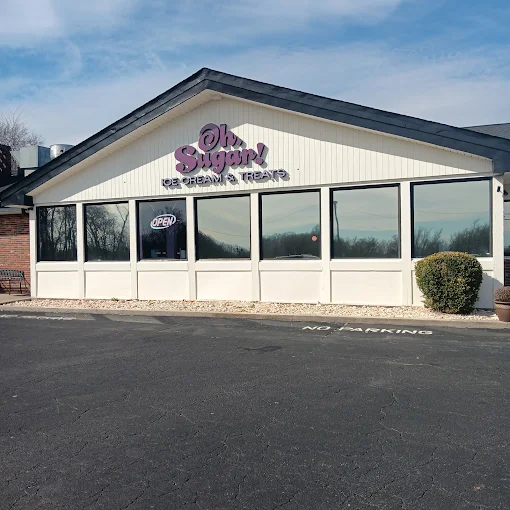
How Oh Sugar Became One of Eden's Sweetest Success Stories
Discover how Oh Sugar transformed from a small restaurant to Eden's top-ranked restaurant destination through strategic web design, SEO optimization, and community partnerships including their 2-year anniversary fundraiser for Morehead High School.