Carousel Posts as a Structural Advantage in Social Media: A Comprehensive Analysis of Engagement, Algorithms, and Strategic Communication
Discover why carousel posts outperform single-image content through cognitive science, algorithmic optimization, and strategic information architecture. Learn how to leverage carousel content for sustainable digital growth.
Introduction: The Hidden Architecture of High-Performing Content
In contemporary digital ecosystems, the success of social media content is rarely accidental. While many businesses interpret high-performing posts as the result of creativity or visual appeal, a more precise explanation lies in structural alignment between human cognition and algorithmic systems.
Social media platforms are not neutral spaces. They are complex, data-driven environments designed to prioritize specific behavioral patterns. Content that aligns with these patterns is amplified, while content that does not is marginalized regardless of aesthetic quality or effort.
Among the various content formats available to modern businesses, carousel posts represent one of the most structurally optimized forms of communication. Their effectiveness is not merely a function of design or trend adoption, but rather a consequence of their compatibility with cognitive processes, algorithmic evaluation metrics, and information architecture.
This article presents a rigorous, foundational examination of carousel posts. It explains why they outperform single-image posts, how they interact with platform algorithms, and why they represent a strategic tool for businesses seeking sustainable digital growth rather than transient visibility.
By the conclusion of this analysis, it will become evident that carousel posts are not optional enhancements to social media strategy. They are an essential infrastructure for effective communication in algorithmically mediated environments.
What Are Carousel Posts?
Before examining why carousel posts work so effectively, it's essential to understand what they are.
A carousel post is a multi-slide social media post that allows users to swipe or click through multiple images, graphics, or pieces of content within a single post. Instead of displaying one static image like a traditional post, carousel posts contain multiple slides that users navigate sequentially.
You've likely encountered carousel posts on platforms like Instagram, Facebook, LinkedIn, and Twitter. They typically display small dots or indicators showing how many slides are available, and users swipe left (on mobile) or click arrows (on desktop) to view the next slide.
For example, a business might create a carousel post with:
- Slide 1: A headline introducing a topic
- Slide 2: An explanation of a problem
- Slide 3: A solution or approach
- Slide 4: Supporting evidence or examples
- Slide 5: A call to action
This format allows businesses to tell complete stories, explain complex concepts, showcase multiple products, or provide step-by-step guides within a single post.
The key difference between carousel posts and traditional single-image posts is that carousel posts distribute information across multiple frames, creating a structured narrative that users actively navigate rather than passively consume.
Here's a real-world example of a carousel post in action:
As you can see in this example, carousel posts allow for structured storytelling that guides viewers through multiple slides, each building upon the previous one to create a complete narrative.
1. The Attention Economy and the Limits of Traditional Content
1.1 Attention as a Scarce Resource
In digital environments, attention functions as a scarce resource. Users are exposed to thousands of stimuli daily, including advertisements, entertainment content, news updates, personal messages, and algorithmically curated media. As a result, individuals develop rapid filtering mechanisms that allow them to evaluate content within fractions of a second.
Traditional single-frame posts (also called single-image posts) operate under severe constraints within this environment. These are the standard social media posts that display one image or graphic. They must communicate meaning instantly. If the message is unclear, unremarkable, or cognitively demanding, the user disengages and continues scrolling.
This dynamic creates a structural disadvantage for complex ideas, nuanced explanations, and educational content. Businesses that attempt to communicate depth within a single visual frame often fail, not because their ideas lack value, but because the format itself is incompatible with human attention patterns.
Carousel posts address this limitation by distributing meaning across multiple frames. Instead of demanding immediate comprehension, they invite progressive engagement. This transformation fundamentally alters the cognitive relationship between the user and the content.
1.2 From Passive Consumption to Active Interaction
A critical distinction between single-frame posts and carousel posts lies in the nature of user engagement.
Single-frame posts encourage passive consumption. The user scrolls past, sees one image, and either reacts (likes, comments) or ignores it and continues scrolling. The interaction is binary: engage or don't engage.
Carousel posts, by contrast, require active participation. Each swipe to view the next slide constitutes a deliberate action, however minimal. This action transforms the user from a passive observer into an active participant in the content experience. They're making a series of micro-decisions to continue engaging with your content.
From a psychological perspective, this shift is significant. Active participation increases cognitive investment, which in turn increases attention, retention, and emotional connection to the content. When users invest their time and actions into your content, they're more likely to remember it and act on it.
In practical terms, carousel posts do not merely present information. They orchestrate interaction. Every swipe is a small commitment that builds toward deeper engagement.
For businesses seeking to maximize engagement, social media management services that understand these dynamics can transform content performance.
2. Algorithmic Evaluation and Behavioral Signal Amplification
2.1 How Social Media Algorithms Interpret Engagement
Social media algorithms are the behind-the-scenes systems that determine which content appears in users' feeds and how widely it's distributed. Although the precise mechanisms remain proprietary, their operational logic can be inferred through empirical observation. Platforms prioritize content based on a combination of behavioral signals, including:
- Time spent on a post (how long users view it)
- Frequency of interactions (likes, comments, shares, swipes)
- Depth of engagement (how many actions users take)
- Likelihood of content being saved or shared
- Probability of prolonged user retention (keeping users on the platform longer)
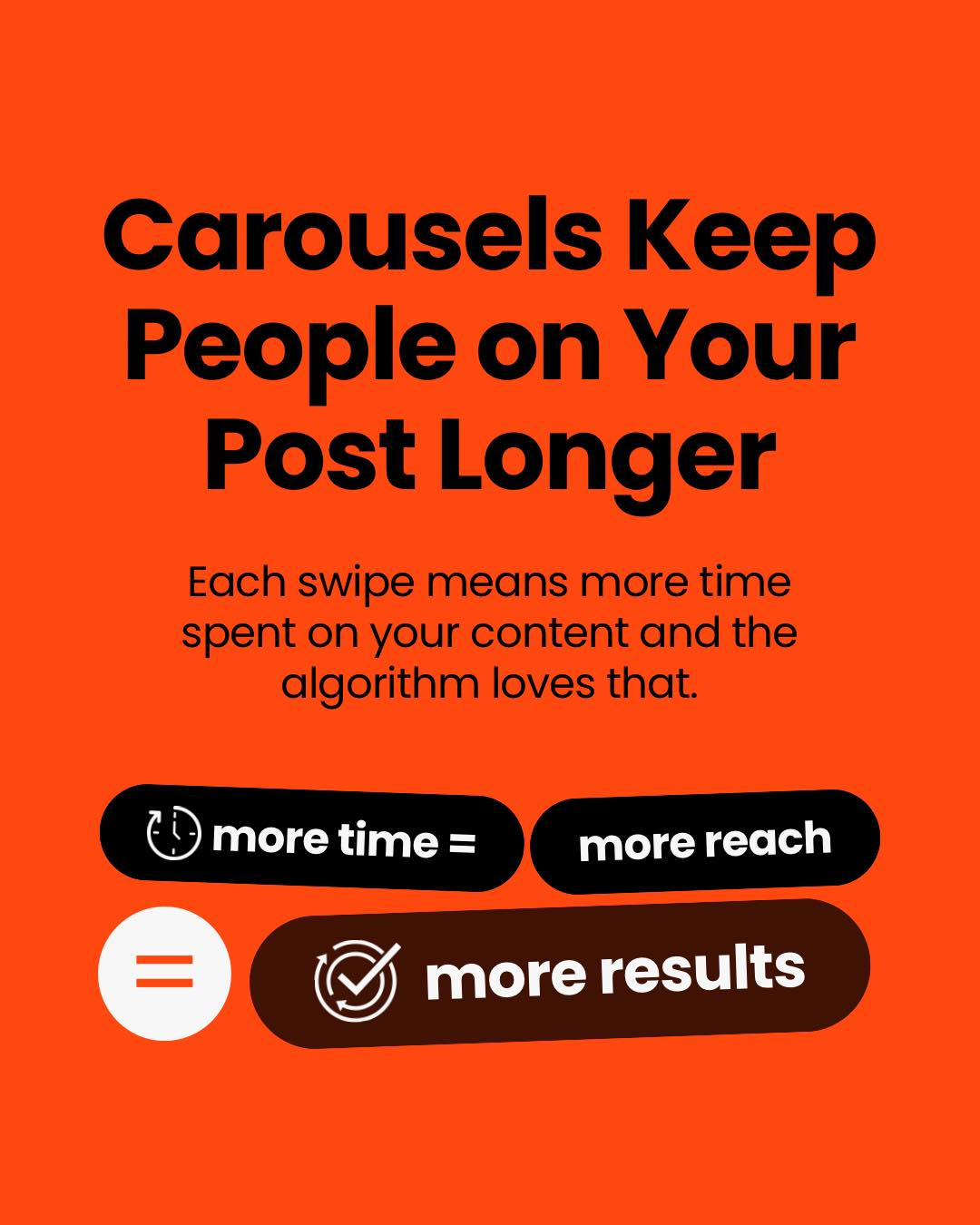
Carousel posts naturally generate a higher volume and diversity of these signals compared to single-image posts.
Each swipe contributes to interaction frequency. Extended viewing time increases dwell time. Completion of multiple slides increases engagement depth. Saving a carousel post often indicates perceived informational value.
Collectively, these signals communicate to the algorithm that the content is relevant, valuable, and worthy of broader distribution.
Thus, carousel posts function as signal amplification mechanisms within algorithmic systems.
Businesses that understand these mechanisms can leverage marketing strategy development to optimize content for algorithmic performance.
2.2 Signal Density and Algorithmic Favorability
An important concept in understanding carousel performance is signal density.
Signal density refers to the number and quality of behavioral signals (user actions like swipes, views, interactions) generated per unit of content exposure. Think of it as how much engagement data a single post produces.
Single-image posts typically generate limited signals, such as a like or brief view. The user sees the image, may or may not like it, and moves on.
Carousel posts generate multiple sequential signals within the same exposure event. Each swipe to the next slide counts as an interaction. The time spent viewing multiple slides increases dwell time. Completing the entire carousel shows deeper engagement. This creates a richer dataset for algorithmic interpretation.
Platforms reward content that produces rich behavioral data because it enhances predictive accuracy in user modeling. As a result, carousel posts often receive preferential distribution.
This phenomenon explains why businesses frequently observe that carousel posts achieve higher reach and engagement than other formats, even when the visual quality is comparable.
Understanding signal density requires analytical frameworks that measure engagement beyond surface-level metrics.
3. Cognitive Load Theory and Information Architecture
3.1 The Problem of Overcompression in Single-Frame Content
Effective communication depends not only on the quantity of information conveyed, but on the structure through which it is delivered.
Single-frame posts frequently suffer from one of two structural deficiencies:
- Oversimplification, in which complex ideas are reduced to superficial statements that lack depth or nuance.
- Overcompression, in which excessive information is forced into a limited visual space, making it difficult to read or understand.
Both outcomes undermine comprehension and reduce engagement. Users either don't understand the message or feel overwhelmed trying to process too much information at once.
Carousel posts mitigate these problems by enabling segmentation of information into discrete units. Each slide functions as an independent cognitive unit while contributing to a larger conceptual framework. Instead of cramming everything into one image, you can spread it across multiple slides.
This segmentation aligns with cognitive load theory, which posits that learning is optimized when information is distributed across manageable chunks rather than presented all at once.
3.2 Sequential Processing and Memory Formation
Human cognition is inherently sequential. Individuals process information in ordered sequences rather than isolated fragments.
Carousel posts leverage this cognitive architecture by presenting information in a structured progression. Each slide builds upon the previous one, creating a logical narrative.
This structure enhances memory retention by transforming content into a coherent mental model rather than a collection of disconnected facts.
For businesses, this has profound implications. Content that is remembered is more likely to influence future decisions. Content that is forgotten is functionally irrelevant.
4. Carousel Posts as Narrative and Persuasive Systems
4.1 The Architecture of Argumentation
At their most effective, carousel posts resemble academic arguments.
A high-quality carousel often follows a structure analogous to scholarly discourse:
- Introduction of a problem or question
- Contextual explanation
- Analytical breakdown
- Presentation of evidence or examples
- Implications for the audience
- Concluding insight or call to action
This structure mirrors the logic of persuasive writing, scientific reasoning, and philosophical argumentation.
By adopting this architecture, carousel posts transcend the role of promotional content and become instruments of structured persuasion.
4.2 Meaning Construction and Brand Authority
Modern audiences are increasingly resistant to overt advertising. They are more receptive to content that explains, contextualizes, and interprets.
Carousel posts excel in this domain because they enable brands to construct meaning rather than merely present offers.
When a brand consistently provides structured explanations, it positions itself as an authority. Authority generates trust. Trust influences purchasing behavior.
In this sense, carousel posts function as epistemic tools. They shape how audiences understand an industry, a problem, or a solution.
Brands that control interpretation often control markets.
Effective content marketing portfolio examples demonstrate how carousel posts establish interpretive authority within competitive markets.
5. Strategic Implications for Businesses
5.1 Why Most Businesses Fail to Leverage Carousel Posts
Despite their potential, many businesses fail to realize the full value of carousel content. Common errors include:
- Prioritizing visual design over conceptual clarity
- Presenting disconnected slides without logical progression
- Delivering generic information without original insight
- Neglecting narrative structure
- Failing to align content with audience cognitive needs
These errors stem from a misunderstanding of what carousel posts represent. They are not decorative formats. They are intellectual frameworks.
Understanding proper content creation process prevents these common failures and maximizes carousel effectiveness.
5.2 Carousel Posts as Competitive Differentiation
In saturated markets, differentiation is rarely achieved through products alone. It is achieved through interpretation.
The brand that explains complex ideas more clearly than competitors becomes the reference point within its industry.
Carousel posts provide an ideal medium for interpretive authority because they combine visual clarity with conceptual depth.
Over time, consistent use of high-quality carousel content can transform a brand from a participant in a market into a definitional force within it.
Real-world marketing campaign results demonstrate how carousel-driven differentiation creates sustainable competitive advantages.
6. Designing High-Performance Carousel Content
Creating effective carousel posts requires strategic thinking about structure and content. Here are the fundamental principles:
6.1 Conceptual Singularity
Each carousel should revolve around a single central idea. Attempting to communicate multiple unrelated concepts within a single sequence dilutes cognitive focus and confuses your audience.
For example, don't create a carousel that covers "5 Marketing Tips" on slide 1, "Our New Product" on slide 2, and "Company History" on slide 3. Instead, create separate carousels for each topic, or structure one carousel around a single theme that connects all slides.
A strong carousel does not attempt to say everything. It attempts to make one idea unforgettable. Focus beats breadth every time.
6.2 Logical Progression
Slides must follow a logical order. Each slide should build upon the previous one, creating a narrative flow that guides readers through your message.
Think of it like telling a story: slide 1 introduces the problem, slide 2 explains why it matters, slide 3 presents a solution, slide 4 provides evidence, and slide 5 offers next steps. Each slide depends on the previous one for full comprehension.
If slides can be rearranged without loss of meaning, the carousel lacks structural integrity. The order should matter. When slides flow logically, readers are more likely to complete the entire carousel.
Logical progression transforms content into argument. Argument transforms content into authority. When your carousel tells a coherent story, you position yourself as a thoughtful expert rather than someone just posting random content.
6.3 Cognitive Reward
Every carousel must provide a cognitive reward. This reward may take the form of insight, clarity, strategy, or reframing of assumptions.
Without reward, engagement collapses. With reward, audiences develop loyalty and anticipation.
7. Carousel Posts and Organic Growth
7.1 The Engagement Visibility Feedback Loop
Carousel posts initiate a self-reinforcing cycle that builds momentum over time:
- Structured content increases engagement (more swipes, longer viewing time, more saves).
- Higher engagement signals to algorithms that the content is valuable.
- Algorithms increase visibility by showing the content to more users.
- Larger audiences generate more behavioral data (more interactions, more signals).
- Increased data strengthens algorithmic distribution (platforms show it to even more people).
This cycle constitutes an organic growth engine. Unlike paid advertising that stops when you stop paying, carousel-driven organic reach compounds over time as the algorithm learns that your content performs well.
Businesses that master carousel content do not rely solely on paid social media advertising. They build structural visibility within algorithmic systems.
7.2 Organic Reach as Strategic Infrastructure
Paid advertising produces temporary exposure. Carousel-driven organic reach produces cumulative visibility.
Over time, brands that consistently publish high-quality carousel content become algorithmically privileged.
This privilege is not accidental. It is the result of systematic alignment between content structure and platform logic.
Businesses can assess their current performance through a free social media audit that evaluates content structure and engagement patterns.
8. Carousel Posts and the Future of Digital Communication
8.1 From Broadcasting to Education
The future of digital marketing is not louder messaging, but deeper explanation.
Audiences increasingly gravitate toward brands that teach rather than announce.
Carousel posts represent a transitional form between marketing and education.
They allow brands to function as knowledge producers rather than mere advertisers.
8.2 From Content Creation to Knowledge Architecture
Most businesses think in terms of posts. Advanced brands think in terms of knowledge systems.
Carousel posts are building blocks of such systems.
When organized strategically, they form a distributed body of knowledge that defines how audiences conceptualize an industry.
This represents the highest level of brand power.
Comprehensive digital marketing services integrate carousel content into larger knowledge architectures that establish market authority.
9. The Koford Media Perspective
At Koford Media, content is not treated as decoration. It is treated as infrastructure.
Every carousel post is designed as a cognitive system, an algorithmic signal generator, and a narrative structure.
Rather than asking what to post, we ask what the audience should understand after encountering the brand.
Most agencies produce content. We engineer perception.
For businesses seeking to move beyond superficial visibility toward structural influence, carousel posts represent one of the most powerful tools available.
Work with Koford Media to transform your social media strategy from content creation to knowledge architecture.
Frequently Asked Questions About Carousel Posts
What is a carousel post in social media?
A carousel post is a multi-slide social media post that allows users to swipe through multiple images or pieces of content within a single post. It is commonly used on platforms such as Instagram, LinkedIn, and Facebook.
Why do carousel posts get more engagement?
Carousel posts generate more engagement because they increase time spent on content, encourage active interaction through swiping, and deliver information in structured sequences. These factors produce stronger behavioral signals for social media algorithms.
Are carousel posts better than single-image posts?
In many cases, yes. Carousel posts often outperform single-image posts because they distribute information across multiple frames, enhance comprehension, and align more effectively with algorithmic ranking metrics.
How should businesses use carousel posts?
Businesses should use carousel posts to educate audiences, explain complex ideas, showcase multiple offerings, and build brand authority. Effective carousels follow a logical progression and provide meaningful insights rather than superficial information.
Do carousel posts help with organic reach?
Yes. Carousel posts often improve organic reach because they generate higher engagement signals, which algorithms interpret as indicators of valuable content. This can lead to increased distribution without paid advertising.

Written by
Zack Koford
View profileFounder of Koford Media. Full-stack developer passionate about creating handcrafted websites that convert visitors into customers. Specializing in Next.js, React, and modern web technologies.
Keep reading
Related articles
How to Make Social Media Work Like a Sales Funnel
Posting content isn't marketing. Learn how to structure social media as a complete sales funnel that moves audiences from awareness to purchase systematically.
Content Longevity: Building Digital Assets That Outlive Algorithms
Social media rewards viral hits. Blog content rewards patience. Learn how to create evergreen assets that compound traffic and authority over years, not days.
Designing With Content, Not Around It
Most designers treat content like luggage to pack after layout is done. This approach fails users who experience meaning, not design. Learn content-first methodology.